
What the Open Ocean Does to Your Sense of Scale
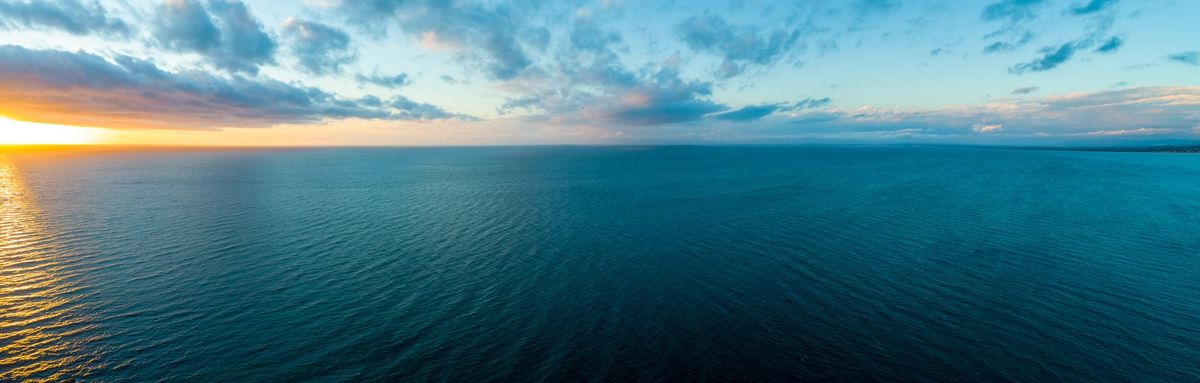
There is something unsettling about looking out from a ship and seeing nothing but water. No buildings; no road; no mountains on the horizon. Perhaps most daunting, no familiar point of reference.
Just ocean.
It is difficult to appreciate the scale of it from a map. On a map, the Atlantic is a patch of blue separating two shapes. From the deck of a ship, it becomes something entirely different. It becomes enormous, and you become very small.
That is one of the things I was reminded of recently while traveling by ship. Modern cruising makes ocean travel remarkably comfortable. You can eat dinner, see a show, sleep in a climate-controlled room, wake up the next morning, and find yourself hundreds of miles from where you started. Technology has made the experience so routine that it is easy to forget what is actually happening: You are crossing an environment in which human beings are profoundly out of place.
Take away the ship, the navigation systems, the engines, the communications equipment, the charts, and several thousand years of accumulated maritime knowledge, and the ocean very quickly reminds us of the enormity, the grand– even terrifying– scope of travel by sea. That realization does something useful to a man ... it calibrates his sense of scale.
Someone Had to Go First
The modern traveler also has the luxury of forgetting how astonishing ocean travel actually is. Long before satellites, GPS, radar, weather forecasting, radio, or powerful engines, men went to sea. They learned to read stars. They studied wind. They watched currents. They learned the behavior of birds, clouds, waves, and coastlines. They developed instruments, charts, shipbuilding techniques, mathematics, and bodies of knowledge that were often purchased at enormous human cost.
And then– the critical part– they sailed beyond what they could see.
There is something fundamentally different between traveling toward a destination you can see and deliberately moving beyond the visible horizon. At some point, the shoreline disappears. Behind you is the known world, ahead is uncertainty. Someone still has to keep going.
That is one reason the history of navigation and exploration continues to fascinate us. It is not merely a collection of old voyages. It is the story of human beings repeatedly extending the boundary of what they knew how to do.
Civilization Is Accumulated Courage
Standing aboard a modern ship, it is tempting to attribute the entire experience to technology. But technology does not appear spontaneously. Every reliable system rests on generations of experimentation. Someone observed, someone calculated someone built. Someone failed, someone drowned, someone tried again.
Eventually, dangerous knowledge became ordinary knowledge. That process is one of the great engines of civilization. We inherit solutions to problems that earlier generations had to confront directly. The extraordinary becomes mundane infrastructure, and then we forget how extraordinary it was.
Much of what we regard as ordinary life exists because somebody before us was willing to confront a problem that did not yet have an answer. Businesses are built this way. Institutions are built this way. Families are built this way. Countries are built this way.
Progress usually looks obvious only after somebody else has taken the risk.
Go Somewhere That Makes You Smaller
One of the best reasons to travel is to encounter something that exceeds you.
A mountain.
An old cathedral.
A battlefield.
A desert.
A forest.
A city older than your country.
Or an ocean stretching farther than your eyes can see.
Stand there long enough to remember that the world is very large and your own life occupies only a small part of it. Then come home and take that small part seriously. There is work waiting. There are people depending upon you. There are things worth building.
But perhaps you will approach them with slightly better proportions.
The horizon has a way of doing that.